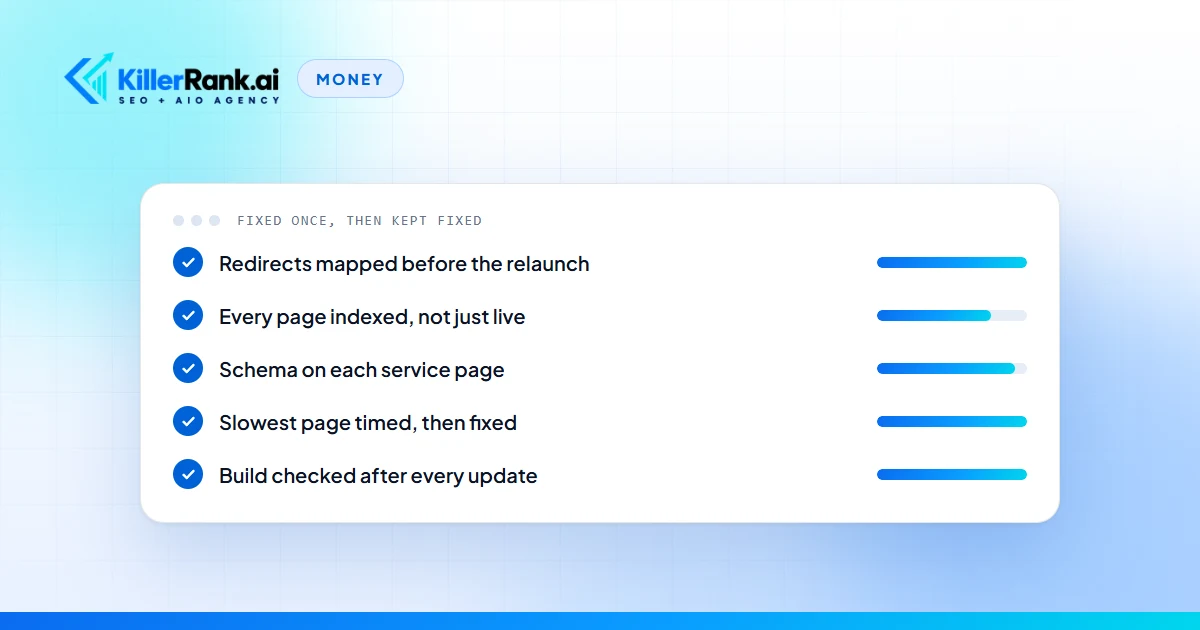
Technical SEO is the line on a quote that owners understand least and question least, which is why it gets padded most. It sounds like something you cannot judge, so you pay for it. The truth is simpler. Some of it is a one time cleanup. Some of it is monthly maintenance. And on a plan that is doing its job, none of it is a premium.
I run SEO for small businesses across the country, and part of that is reading audit scores for every site we manage on a schedule. Those scores move, in ways that have nothing to do with SEO and everything to do with someone editing a website. This post is about what technical and on page SEO services actually are, which part you buy once, which part you buy monthly, what a retainer has to show you by name, and how to tell when the line is plumbing sold as a feature.
What are technical SEO services, and what are on page SEO services?
Technical work answers one question. Can a search engine find this page, load it quickly, and understand what it is? Indexing covers found. Speed and the server cover quickly. Structured data, which is a block of markup on the page that says this is a service, this is a business, this is a question and its answer, covers understand. Redirects, sitemaps, canonical tags and robots files are the signposts that keep all of that pointing the right way. Security headers and a valid certificate are the lock on the door.
On page work answers a different question. Now that the page loads, does it say the right thing? The title tag, the single H1, the headings, the body copy, the alt text on every image, and the links to your other pages. The how-to for the on page side is in the on page checklist on our agency site, and I am not going to repeat it here. The buying question is the same for both: which of this is a fix, and which is upkeep?
Which technical SEO work is a one time job?
The clearest example is a redesign. When a site is rebuilt, the old addresses stop existing. Every one of them that had a ranking needs a redirect to the right new page, and that map is built once, before launch, or the rankings are gone the morning after. What that looks like when it goes wrong is in the website redesign post on our agency site, and the redirect case is one of the seven causes in why your website is not showing up.
The second example is the one nobody notices without tools. A voice talent site we run has 102 pages. For months, every one of those pages carried a canonical tag that pointed at a copy of itself ending in .html, and the host redirected that address back to the clean one. So each page told Google its official address was a redirect. Search Console was quietly indexing the .html copies as separate pages. We found it on October 1, 2026 and fixed it in the page template, once. It did not need a monthly line. It needed one person to look.
Structured data is the same shape. Setting it up on the service pages, the business entity, the FAQ blocks, is one job. The schema side of AI search gets its own explainer in schema markup for AI search on our agency site. Once it is on the template, every new page inherits it. On our plans, this whole category is the setup: the plans page itemizes a one time onboarding fee for tracking setup, technical work, profile and listing cleanup and the first content plan, and waives it on every tier.
Which technical work belongs in every month?
Here is why I know the monthly part is real. A fleet services company we manage had a speed score of 90 on July 17, 2026. On September 30 it read 80. On October 1 it read 59, with the largest element on the homepage taking 10.1 seconds to paint and scripts blocking the page for 420 milliseconds. Its technical score was 100 on every one of those reads. Nothing on the SEO side changed. Something on the website did, and the speed went with it. That is the kind of fault a yearly audit finds nine months late.
A collections consultant’s site had every image carrying alt text on September 14. On October 10 it had 17 of 45 missing, and its on page score fell from 100 to 88. A pet supply store’s server was answering in 826 milliseconds on October 10, and a communications company’s server was taking 1,675 milliseconds on September 30, with a 338 character meta description and two H1 tags on the homepage that nobody had meant to put there. None of those are mysteries. They are what a site looks like a month after a person with admin access edited it.
The build is the one owners never think about, and it is the one that scares me. On October 19, 2026, a framework update raised the minimum server version it needed, and in one morning the publishing builds for eight of the sites we run failed. Every one of those sites stayed live and looked fine, because a static host keeps serving the last successful copy forever. Nothing was visibly wrong. New posts simply would not have appeared. The fix was a one line version file in each site. The lesson is that a check has to run after every update, and now one does, every day, across the whole fleet. Our own agency site taught us the same thing in August, when six published posts quietly returned a not found page for two days after an upgrade.
One more, because it is invisible from the outside. On October 19 we found that three client sitemaps had not updated since June, September and early October, while the sitemap index file that lists them looked fresh. Every post published in between was live and absent from the sitemap. A technical line that says sitemap submitted at setup would have been true and useless.
What should a technical or on page retainer show you by name each month?
The test is the same one I use for every line in what should be in an SEO package. Can it be checked? A technical report that passes looks like this. A count of pages crawled on a date. A list of what failed, by page, in plain words: this service page is not indexed, this image on the homepage is 2 megabytes, this old address returns a not found page and had rankings. Then what was done about each, and the reading afterward. Speed score on the homepage was 59, the two scripts were deferred, it is now 81. That is a sentence an owner can verify in a free tool in thirty seconds.
What a padded one looks like is also easy to describe. Monthly technical monitoring. Ongoing site health. Core web vitals optimization, every month, with no page and no number. Those lines are satisfiable by running a crawler and attaching the export. Our own monthly report carries the audit score and the open faults by page because that is the only way the technical line proves it exists.
A fair version of the month-with-nothing-wrong is also worth knowing. Most months on a stable site, the re-read passes. The report should say so, name the date and the checks, and move on. Zero faults found is a legitimate result. Zero faults looked for is not.
When is technical SEO plumbing sold as a premium?
Read any SEO quote and find the technical line. Then ask one question: if I do not buy this, what happens to the rest of the plan? If the honest answer is that the content will go on pages Google may not index, on a site that takes ten seconds to load, then the technical work was never optional and the plan without it was never a plan. If the honest answer is that it would be fine, then the line is padding, and the cheap SEO post covers what the rest of that quote probably looks like.
On our plans page, technical, schema and page speed fixes, the robots.txt, llms.txt and security headers, and indexing with Search Console and Analytics management are listed on every tier, starting with Starter at $997 a month. They are not a feature of Growth. Growth adds links, new pages and citations. The technical work does not get better as you pay more. It gets done, on every plan, because nothing else we do works without it. The done for you post lists the whole monthly engine.
The other tell is a technical line priced per fix. A proposal that lists speed optimization at one figure, schema implementation at another and redirect mapping at a third is a menu, and a menu is a consultant’s deliverable, not a company’s. That can be the right purchase. The audit cost post covers when a one time paid look is worth it. It is not the same thing as a monthly plan, and it should not be priced like one.
How do you check whether the technical work was actually done?
This is the one category of SEO work an owner can verify without trusting anyone. Open Search Console, which you should own and which how it works says we set up and manage on every plan. The pages report shows indexed and not indexed, with reasons. If the report says indexing was handled and the not indexed list is full of your service pages, it was not handled.
Speed is a number. Put the homepage into any free page speed tool and read it. Then put in the slowest page the report named. If the invoice says speed optimization and the number has not moved in three months, ask what was optimized. Redirects are a click: find an old address from before the redesign, type it in, and see whether it lands on the matching page or on a not found page or the homepage.
For everything else, run the free audit. It checks five areas, 21 items, and gives a score out of 100. Compare its fail list to the last three technical reports you were sent. Anything that fails today and was marked fixed last quarter is a conversation. The choose post has the rest of that conversation.
Which plan fits, and when should you only buy a one time cleanup?
For most owners the answer is that technical SEO is not the purchase. It comes with the purchase. Starter carries the whole technical and on page floor, the audit at setup, the indexing, the schema, the speed fixes, the robots and llms files and the security headers, plus four posts a month and the tracking. Growth is where links, pages and citations start, which is the work that moves a site against competitors once the floor is solid. The cost post walks the four prices line by line.
The honest case for a one time job is narrow and real. A redesign or a domain move needs a redirect map and an indexing check around launch, and that can be bought as a project. A site with a fault you can name, the canonical problem, the blocked pages, the ten second homepage, can be fixed as a project. And a business with one location, no competitor publishing, and customers who already find it by name mostly needs its site to load and be indexed, which is a cleanup, not a retainer.
The catch is the part this whole post is about. The fleet services company’s speed did not fall because of anything an SEO did. It fell because the site is alive. If you buy the cleanup and nobody re-reads the site, you are back where you started by spring, and you will not know. Buy the fix once. Then make sure someone is looking, whether that is a plan, a person on your side, or a calendar reminder to run the audit yourself. The free audit takes about a minute and will tell you today what is broken, and the seven day free trial starts with the cleanup done.
Questions We Get Asked
What is included in technical SEO services?
The work that lets Google and the AI tools read your site at all. Crawling and indexing, so every page you want found is in the index. Redirects, so old addresses land on the right new page. Canonical tags, sitemaps and robots files. Structured data, which is the markup that tells a search engine what a page is. Page speed and the server behind it. Security headers and HTTPS. On our plans all of that is included on every tier, with the first cleanup done at setup.
Is technical SEO a one time thing?
Part of it is. A redirect map after a redesign, an indexing fault, a missing schema setup or a wrong canonical gets fixed once and stays fixed as long as nobody touches it. The rest is maintenance, because sites get touched. A new plugin, a form embed, an uncompressed photo or a framework update can take speed, alt text or a whole build down in a day. Something has to be looking every month.
What is the difference between technical SEO and on page SEO?
Technical SEO is whether a search engine can reach and read the page: indexing, redirects, speed, sitemaps, canonicals, structured data. On page SEO is what the page says once it gets there: the title tag, the headings, the words, the image alt text, the internal links. A page can be technically perfect and say nothing useful, or say the right things on a page Google never indexes. You need both, and both are on every plan we sell.
How much do technical SEO services cost?
We do not sell them on their own, so there is no standalone price on our plans page. The technical work, schema and page speed fixes, the robots and llms files, security headers, indexing and Search Console are included on every plan starting with Starter at $997 a month, and the one time technical cleanup is part of the setup fee, which is itemized on the plans page and waived. If someone quotes you technical SEO as a separate monthly line, ask what is in it page by page.
How often should a technical SEO audit be done?
A full one at the start, and a re-read every month after that. Every site we run gets its audit score re-checked on a schedule, and the scores move. The fleet services company in this post dropped from 90 to 59 on speed between July and October 2026 with no SEO change from us, and a collections consultant lost alt text on 17 images between two reads a month apart. A yearly audit would have found both about nine months late.