A cheap SEO quote lands in your inbox, a few hundred dollars a month, and it promises most of what the expensive one promised. The question is never whether cheap can work. Sometimes it can. The question is what the low number is actually buying, because the answer is one of three very different things, and only one of them is honest work in a smaller amount.
I run SEO for small businesses, and part of that job is reading what the last provider left behind. This post is about what the low end really delivers, what it looks like on a site a year later, and when paying less is the right call. The two examples in it are real, pulled from our tracking on October 15, 2026, with the clients anonymized.
What do cheap SEO services actually buy?
Cheap is a price, not a product. Two companies can quote the same few hundred dollars a month and deliver completely different things, which is why the question to ask is never “why is this one so cheap” but “what does this one do each month, by name.”
The post on what SEO costs a small business covers why quotes spread so widely and how to compare two of them line by line. This post is about the bottom of the range: what is sold down there, what it does to a site, and when it is enough.
Here is the honest frame. Original content and real links are the expensive parts of SEO, because they take skilled hours. A cheap quote has to leave one or both out, or fake them. Leaving them out can be fine. Faking them is where the damage comes from.
What are the three shapes cheap SEO comes in?
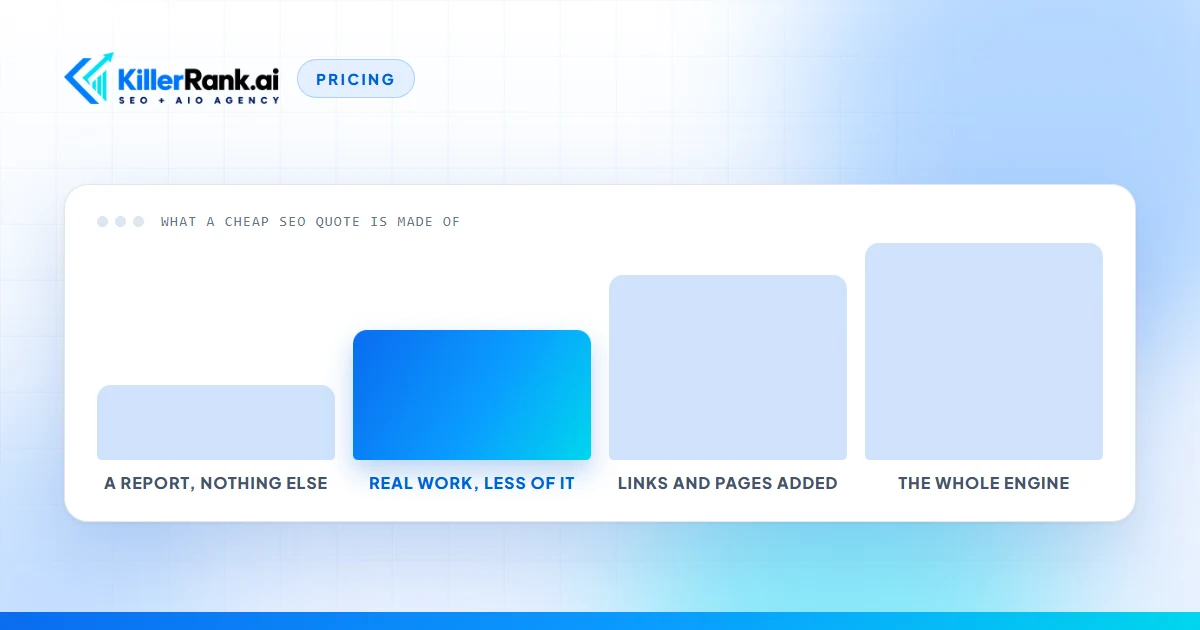
The link package. The fee buys “authority links” or “backlinks” by the dozen, delivered from a network of free blog sites that exist only to hold them. It is the cheapest thing to sell because it is the cheapest thing to make. I wrote about what a real link looks like on an invoice in the link building post, so the short version here: a real link comes from a site with readers of its own, points at a page you want ranking, and arrives by the handful. A package arrives by the hundred from sites with no readers at all.
The software service. A tool crawls your site every month and produces a report of issues: missing titles, slow pages, broken links. The report is the deliverable. Nobody fixes anything, publishes anything or builds anything. Software itself is not the problem. The hire post covers the do it yourself route with software honestly, and for an owner who will do the work, it is a good route. The cheap shape is software sold as a service with no service behind it.
The stretched operator. One person, often skilled, with more clients than hours. You get a post some months, a profile fix when they get to it, and a report that is mostly positions. This is the only one of the three that is real work. The problem is dose. The same person with ten clients would move your site. With forty, nothing happens fast enough to notice, and you quit in month four with nothing to show.
What does a cheap link package leave behind?
Here is what the link package looks like a year or three later, read straight from our backlink tracking on October 15, 2026.
A carpet cleaning company in the Midwest has 72 active referring domains. Of those, 31 have a domain rank under 10 and 13 have a rank of zero, which means the sites linking to it have no authority to pass. Twenty of the 72 are free hosted blogs on two platforms, the kind you can create in a minute with no name attached, and between them they point 44 links at the site. They did not arrive at once. Five appeared in October 2023, then one or two at a time through 2024 and 2025, with the newest first seen in June 2026. That trickle is what a monthly link package looks like from the outside: a small delivery every few weeks, from a different disposable blog each time.
The six strongest domains in the same profile are all business directories, with a rank of 50 to 65. Five of the six are nofollow, which means they pass nothing. They are citations, which are useful for a local business and are not authority links, a difference I covered in the link building post.
A pool company in Ohio has a much bigger profile, 615 active referring domains, and the package is easier to spot because it arrived as a batch. Thirty nine of those domains are free hosted blogs, and 28 of them were first seen in October and November 2023. Twenty two in a single month. Nobody earns 22 links from 22 new blogs in one month. Someone bought them, and the profile has carried them since. Across the whole profile, 88 domains sit under rank 10 and 50 sit at zero.
Neither company bought those links from us, and both profiles looked like this when we started tracking. I do not know what either paid or who built them. What I know is what it left: a layer of links from sites with no readers, pointing at a business that did nothing wrong, sitting in the profile for anyone to read. That is the cheap link package’s real product.
When is the low end honestly enough?
Here is the part the expensive quotes will not tell you. There are businesses that should not pay for much SEO at all, and I would rather say so than sell them a plan.
The test has three parts. You serve one town, or one small area. People already find you by searching your name, because you have been there a while and the reviews are there. And when you search the things your customers would type, the results are a map pack with a few local names and nobody is writing pages or posts to take it. If all three are true, the gap between you and the top of the results is small, and it is mostly made of things that cost time rather than money.
Those things are the free basics. Claim your Google Business Profile, set the right category, add your services and real photos, and keep it accurate. The Maps post is the checklist. Fix every listing that still has an old address or phone number. Ask every happy customer for a review. Make sure your site has a page for each service that says what town you serve. None of that needs a monthly fee.
If you want to pay a little on top of that, pay for real work in a small amount: a post a month that answers a question your customers actually ask, written by someone who talked to you. That is the honest version of cheap SEO, and for a one town business with no competitor publishing, it is often enough for years. What is never enough, at that size or any other, is a link package, because the business that needs the least is the one with the most to lose from a spam penalty on a site that was doing fine.
How do you tell cheap from a scam on the invoice?
You usually cannot tell the three shapes apart from the sales call. You can tell them apart from the invoice and the first report, and it takes about five minutes.
Links by the hundred, no site named. A real link vendor can tell you which website the link is on and which page of yours it points at, because there are only a few. A package lists a number. If the invoice says 50 backlinks or 200 backlinks and names none of them, that is the free blog network, and the fingerprint above is what it will leave.
Posts that do not appear on your site. If the plan includes content, open your own blog and count. A post counted on the invoice that is not on your site was either never written or was published somewhere you do not own. Either way you did not get it.
A report that is only positions. Positions are one of three things a report should show, next to the work done and what moved. A report with no work in it is the software service. The monthly report post walks through what the other two sections look like.
A term longer than a month. The low end does not need a year to prove itself, because the work is small enough to see in the first report. A twelve month term on a cheap plan is there to collect the months after you notice. The choose post covers the rest of the red flags, and the contracts post covers how to get out of a term you already signed.
The packages post has the line by line test for any bullet on any plan. Run a cheap quote through it and the padding shows up fast, because there is less real work for it to hide behind.
What does honest cheap SEO look like?
I read every line of our own plans page before writing this, because the question of what honest cheap SEO looks like is one I had to answer when we built it.
Starter is our low end at $997 a month. It includes four blog posts a month, tracking on 50 keywords and 60 AI questions, up to five competitors watched, internal links from every post to your money pages, weekly Google Business Profile posts, business listings cleanup, the technical, schema and page speed fixes, robots.txt, llms.txt and security headers, and a monthly report with a strategy call. The setup fee is itemized on the page and waived.
Here is what it does not include, and why. No authority links. No new pages. Those are the two most expensive lines on any plan, because a real link from a real website and a real page written for a real town are the skilled hours. At the Starter price, the honest choice was to leave them out, not to fill the line with free blog links and call it link building. They start on Growth, two of each a month, with 25 citations a year and the Where We Serve map, which is the plan I recommend when a business is actually up against competitors who publish.
That is the whole difference between cheap and scam, in one plan. Cheap says: here is less work, each piece real, and here is what we are not doing. Scam says: here is everything, at the same price, and hopes you never open the backlink profile. How we run the month shows the order the work happens in on every plan, and the SEO company for small business page covers what the engine does whichever tier you pick.
Pay less for real work, never for fake work
The low end of SEO is not a trap by itself. A one town business found by its name can run on the free basics and a little real work for years, and I would rather tell an owner that than sell them a plan they do not need. The trap is the fee that looks like real work and is a link package, a software report, or a person with no hours left for you. Two of those leave nothing. One of them leaves a profile full of free blog links that is still there three years later, on a site that never did anything wrong.
If you want to know what your own site is carrying, run the free audit. It takes about a minute and shows what Google and the AI tools see. If a cheap provider is already on the payroll, pull their last invoice and their last report, and run them through the four tells above. And if you have decided you want real work done, in a dose that matches your market, start the seven day free trial and we begin with a scan of where you actually stand.
Questions We Get Asked
Is cheap SEO worth it?
It depends on what the low price is buying. If it buys real work in a smaller amount, such as a few posts a month and the basics done properly, it can be worth it for a business with little competition. If it buys bought links, copied pages or a report with nothing behind it, it is not worth it at any price, because the cheapest of those can cost you rankings you already had. Ask what the fee produces each month, by name, before you decide.
How much should SEO services cost?
Whatever the work costs to deliver, which is why quotes spread so far apart. Our own plans run from $997 a month for Starter to $4,997 for Dominate, with every line item printed on the plans page. The post on what SEO costs a small business walks through why one quote is three times another, and the honest answer is almost always that they contain different amounts of work.
Can cheap SEO hurt my website?
Yes, in two ways. Links bought in bulk from free blog networks are exactly what Google's spam policies describe, and a site carrying hundreds of them can lose rankings it earned honestly. Pages produced by the dozen with nothing on them a reader could not find elsewhere fall under the scaled content policy. Both leave a record on your site that is still there after the provider is gone.
What is the cheapest way to do SEO for a small business?
Do the free basics yourself. Claim and complete your Google Business Profile with the right category, your hours, your services and real photos. Fix every listing that shows an old address or phone number. Ask every happy customer for a review. Make sure your site loads, has a page for each service and says what town you serve. That costs time, not money, and it beats a small monthly fee that buys a report.
Do I have to pay for SEO?
No. A business found by its own name in one town, with no competitor publishing, can run on the free basics for years. Paying starts to make sense when competitors are publishing pages and posts you are not, when you want work from more than one town, or when the AI tools name someone else for the questions your customers ask. The free audit shows which of those is true for you.