Most of the companies that call us about SEO for pest control are not pest control companies in the way the big franchises are. They do one thing, or one family of things. Moles and groundhogs. Bed bugs. Termites. Bats in the attic. The owner knows the trade cold and knows the phone only rings when somebody in a certain radius has a certain problem and searches for it by name.
We run the search work for a wildlife control company that fits that description exactly: one address, one service family, trapping, and a service area that crosses two state lines. This post is what its numbers taught me about what a one service company should buy, what it should skip, and which plan fits. The contractors post has the trade pattern across several companies. This one is about the company that lives or dies on a single search.
Why does a one service pest control company live on the map and the exact search?
A general pest control company has a dozen searches that can produce a call: ants, roaches, termites, mice, bed bugs, wasps. Lose one, win another, the phone still rings. A company that only traps moles has one. Somebody sees raised tunnels in the lawn, works out it is a mole, and searches mole removal plus their town, or mole trapping near me. That is the whole funnel, and there is no pest control search in it anywhere.
That shapes everything about what to buy. A one service company has to be the answer for its one service in every town it serves, in all three places that answer appears: the map pack, the web result and the AI answer. Our client is tracked on 37 searches as of the October 26, 2026 scan, and almost all of them are the same service with a different town on the end. That is not a thin keyword list. It is what the business is.
Can one address win the map in every town you serve?
This is the single most useful thing the data shows, so here it is plainly. In the October 26 scan our client’s map listing is inside the top ten on four of its 37 tracked searches, and all four are searched from its home metro: the trapping term for its city at fifth, the control term at sixth, the generic get rid of moles search at sixth, and the control service term at ninth. On seventeen of the 37 it has some map position at all, averaging 32nd. On the rest it is not on the map. The town searches further out, the ones with a state line in between, return no map position for it at all.
Now look at the same towns in the web result. Where the company has a page for the town, the web result sits between second and seventh for the exact service plus town search in that same scan: second for the home city’s ground mole term on both desktop and phone, third in one suburb, and fifth and sixth in the two towns across the state line, where the map shows nothing for it at all. Same company, same day, same search phrase: invisible on the map, page one in the web result.
The reason is simple and nobody selling local SEO says it out loud. The map is a proximity product: Google shows the businesses nearest the searcher, then sorts those by relevance and prominence, and no amount of profile work moves the office. The web result has no distance filter. It ranks pages, and a page written for a town can rank in that town from any address. So a one service company with one office has two jobs: win the map near home with the Google Business Profile optimization work, and win everywhere else with a page per town. Our Maps post has the profile checklist, and the multi location post covers what changes once you have a second real address. Until you do, the town page is the only tool that reaches past the circle.
One more number, because it surprised the owner. From the centre of the home metro, the near me version of the removal term shows the company’s map listing at 71st, while the city plus trapping term shows it at fifth. Same business, same city. Near me is measured from wherever the searcher stands, and the office is well outside the centre. No SEO plan fixes that, and a company that says it can is describing work it will not do.
Why do the AI tools name a specialist so often?
We check 22 real buyer questions every week across ChatGPT, Claude, Gemini, Perplexity, Grok and Meta AI, and record whether our client gets named. In the week of October 26, 2026 it was named in 62% of the answers overall: 77% on Grok, 64% on Claude, Perplexity and Meta AI, 60% on Gemini, and 41% on ChatGPT. For a company with one address and no national brand, that is a strong week, and the pattern inside it is the useful part.
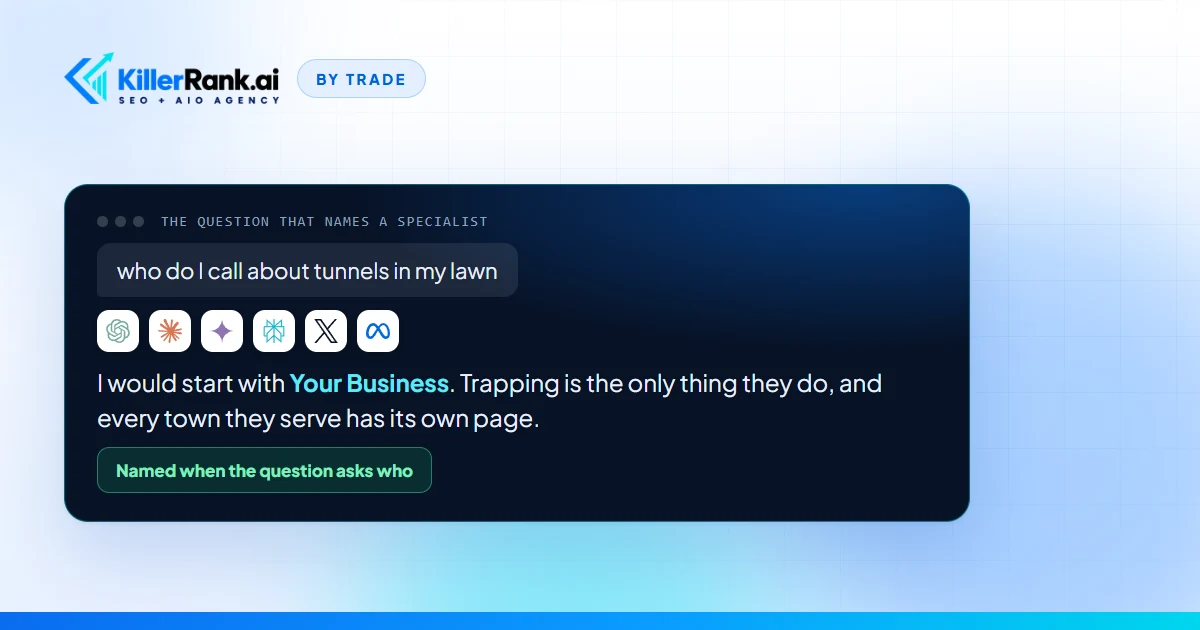
On every question that named the service and asked who, the company was named by all six tools. Recommend a reliable mole trapping specialist near a named suburb: six of six. Best company to get rid of moles in the next metro: six of six. Who removes moles from yards in a town well north of its metro: six of six. The answers quote the same three things each time, all lifted from the site: trapping only, no poison; the counties served, by name; and the phone number. One tool even cited the company’s own post on how to choose a mole removal service when a buyer asked how to choose one. The site answered the question, so the tool used it.
On the questions that described the symptom and asked what to do, the company was almost never named. Mounds of dirt keep appearing in my yard, what should I do: zero of six. Something is digging tunnels under my yard, how do I get rid of it: one of six. The tools read those as how to questions, answer with castor oil and trap placement, and never get to a company. The same symptom with who do I call on the end was named five of six. That is the whole lesson. Say what you do, where and how, in plain words on the service page, and you get named when the buyer asks who. Nothing gets you named while the buyer is still asking what.
The two raccoon questions in the set scored zero of six, and that is correct. The company does not push raccoon work and the site barely mentions it. A one service company gets named for its one service. It will not get named for the services it only takes when asked, and it should not pay anyone to try.
Does a pest control company need blog posts?
Here is the honest shape of a one service company’s traffic. In the 28 days to October 23 the site had 693 clicks from 71,632 impressions at an average position of 8.4. The homepage earned 32 of those clicks from 511 impressions and the trapping service page 10 clicks from 1,130. The post on how many moles are in a yard earned 114 clicks at position 4.4, the post on how a chipmunk gets into a house 95, and the castor oil post 79 from 7,183 impressions. The blog is where the readers are, by a wide margin.
Two things follow, and a company selling you posts will only tell you the first. The posts are the evidence, to Google and to the AI tools, that this company knows moles, and that is part of why the service questions score six of six. But most of those readers are not customers. Somebody in another state asking whether castor oil works is not calling a trapper in the Midwest. The readers who turn into calls are the local ones who read the post, then search the service plus their town, then see the company again. The posts earn the second search. They do not replace it.
So buy posts, but buy the right ones: a post that answers a question your customers actually ask on the phone, carries a real byline at your company, and links to the service page it serves. A count of posts with none of that is padding, and the packages post has the three question test for any content line. Our plans put four posts a month on Starter and eight on Growth, and on a one service company we point every one at the same two or three service pages, because those are the pages that produce a call.
What should a one service company buy, and what should it skip?
In order, this is what we buy for a one service company and why.
The Google Business Profile and the listings come first, because they win the map near home and they are cheap to get right: the right primary category, the services filled in, photos of the work, and the name, address and phone matching on every directory that carries them. Our client’s map positions improved on eleven tracked searches and declined on two between its first scan and October 26, and nothing in that was clever. The profile was accurate and the listings were consistent. The local SEO services page covers what the listings cleanup finds, and the local cost post covers what moves a local quote.
One page per service comes second. Not a services page with a list. A page for mole trapping, a page for vole removal, a page for groundhogs, each saying what the method is, what it costs to find out, where you go and what you promise. That is the page the AI tools quote and the page the service plus town search lands on. Our client’s trapping page averaged position 9.7 in Search Console over those 28 days, and it is the page the tools cite for the method.
A page per town comes third, and only for towns you drive to. Our client’s town pages are what hold second through seventh in the web result where the map cannot reach, including the two towns across the state line at fifth and sixth. Each one is written for that town, which is the difference between a location page and the doorway pages Google’s spam policy describes. A town page is not a guarantee, either: one of the client’s was shown 319 times in the 28 days at an average position of 30, and that is the one we are working on next. A page earns the second search over months, not on the day it goes live.
Posts come fourth, for the reasons in the section above.
What to skip. A page for a town you will not drive to, which is a page for calls you will turn down. A service page for work you only take when asked, which the tools will never cite, as the raccoon questions show. Review management sold as a monthly line, which is not a deliverable on any plan we sell and should not be on anyone’s. A press release, which a one service local company has no announcement for. And paid links before the pages exist, because a link to a page that ranks for nothing is a link to nowhere. The link building post explains when to say no.
Which plan fits a pest control company?
Read our plans page for the full table, because it is the only place the inclusions and prices are kept current. Here is how I would read it for a one service company.
Starter is the full engine: four posts a month, 50 keywords and 60 AI questions tracked, up to five competitors watched, the profile posted weekly, the listings cleaned up, the technical and schema work, and a monthly report with a strategy call. For a company that works one metro and wants to be the answer for its one service there, that is the whole job, at $997 a month.
Growth is where a one service company with a wider area should start. It doubles the posts, tracks 150 keywords and 100 AI questions, and adds the three things that win towns beyond the home circle: two new pages a month starting with the towns you name, two authority links a month pointed at the pages we are pushing, and 25 citations a year. It is $1,997 a month.
Authority and Dominate add industry pages, press releases, more links and more pages. For a company with one service and one address, most of that is firepower pointed at nothing. A one service company that outgrows Growth has usually opened a second office or added a second service, and at that point the multi location post is the one to read. Until then, I would not sell you past Growth, and I would be suspicious of anyone who tries.
If you are not sure which of the two you need, get the free audit. It reads your profile, your listings, your service pages and your town pages against the searches that matter for your service, and shows you where the map stops and the web result has to take over. If you already know, the 7 day trial starts the work this week, and how it works shows what the first month looks like.
Questions We Get Asked
How much does SEO cost for a pest control company?
On our plans it is $997 a month on Starter, which is the full engine for a company working one metro, and $1,997 a month on Growth, which adds two new pages a month, two authority links and 25 citations a year for a company with towns to win beyond its home area. Both prices are on our plans page today. A single location pest control company rarely needs the tiers above Growth.
What is the difference between pest control marketing and pest control SEO?
Pest control marketing is everything that brings in a customer: ads, the truck wrap, referrals, door hangers, the review count and search. SEO is the search part, the work that puts your business in the map, in the web result and in the AI answer when someone asks for your service in your town. It is the one channel that keeps working after you stop paying for the click.
Does a pest control company need a page for every town it serves?
For every town you actually drive to and want calls from, yes, and the data says why. Our wildlife control client's town pages sit between second and seventh in the web result for the exact service plus town searches, in towns where its map listing does not appear at all because the office is too far away. A page for a town you will not serve is padding, and Google's scaled content policy describes it.
Why does my pest control company show up on the map at home but not in the next county?
Because Google's map ranks by distance from the person searching, and a company with one address is close to a small circle of searchers. Our client is inside the map's top ten on four tracked searches, all made from its home metro, and is absent from the map in the towns across the state line while its web result ranks on page one there. The web result does not care how far away your office is. The map does.
Can an SEO company guarantee that ChatGPT will recommend my pest control business?
No, and you should walk away from one that does. What a company can promise is the work that gets a specialist named: a service page that states the method, the area and the guarantee in plain words, a page per town, and a weekly check of the questions buyers ask across the six tools so you see which ones name you. We guarantee that work, never the answer the tools give.