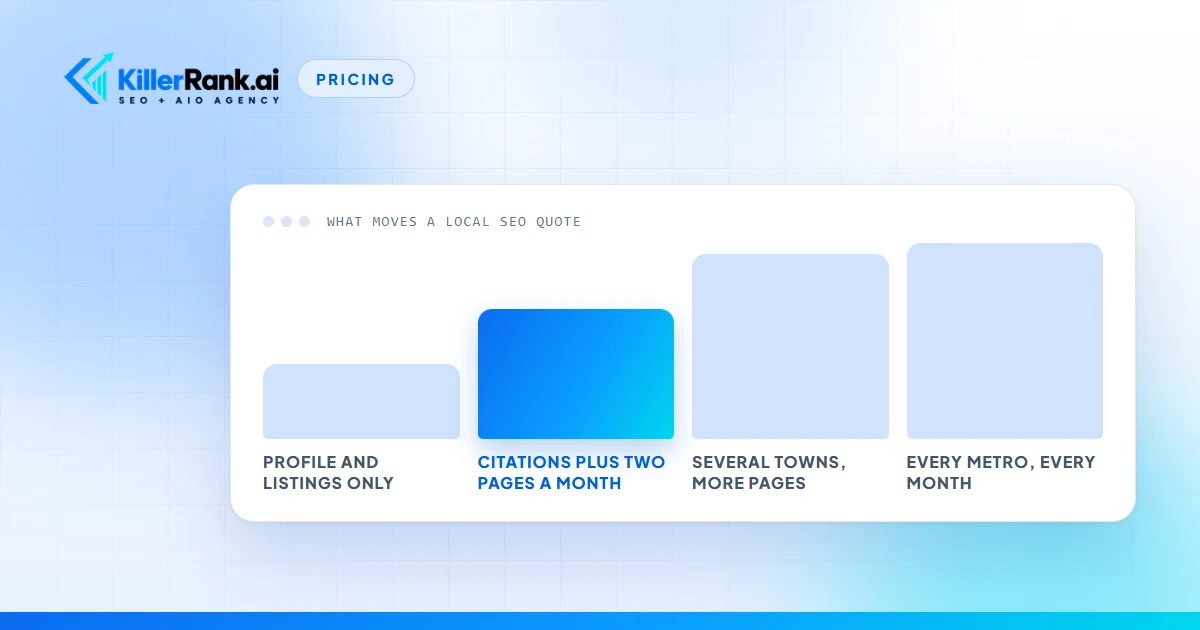
A local SEO quote should be the easiest one to read, because the work is the most concrete. There is a profile. There are listings that are right or wrong. There are towns you serve and pages that exist for them or do not. Yet the quotes I see owners forward to me spread from a few hundred dollars to several thousand a month for what sounds like the same thing, and the proposal rarely says what the extra money buys.
I run this work for local businesses across the country, so I know what a local plan is made of and what makes one honestly cost more than another. This post walks through both, with two real listing scans from our own tracking, anonymized, so you can see what the cleanup line on a quote actually finds. The only prices in it are ours, from the plans page, because quoting a market range would mean guessing at other people’s invoices.
How much does local SEO cost?
Here is the honest shape of it. The local basics are not where the money goes. Keeping a profile accurate, posting to it weekly and correcting listings are steady, repeatable work, which is why we put them on every plan including Starter at $997 a month.
The price climbs when the work multiplies. A business that serves one town needs one profile kept right and its listings to agree. A business that serves eight towns needs eight pages written for those places, a map on its homepage pointing at them, and enough citations that its details are trusted in all eight. That is more skilled hours every month, and it is why Growth at $1,997 adds two place pages a month and 25 citations a year, Authority at $2,997 doubles both and adds industry and service pages, and Dominate at $4,997 builds eight pages a month down to the metro level with every data aggregator network.
The post on what SEO costs a small business covers why quotes spread so far apart in general and how to compare two of them line by line. This post is the local version: what is in the package, what moves the number, and when the cheapest plan is enough.
What is actually in a local SEO package?
The word “local” gets attached to a lot of proposals that are really general SEO with a town name typed in. A local business needs the website work too, because a buyer who taps through from the map lands on the site, and Google weighs how trusted the business looks across the web. But the local line items are specific, and you should be able to find each one.
The profile. The listing that shows on the map is your Google Business Profile, and it needs the right primary category, your services, hours and service areas filled in, real photos, and a post every week. The Google Business Profile optimization page lists the six things we do to it. We do not sell it on its own, because the profile is half of what Google looks at.
Listings cleanup. Every listing of your business on another site that shows an old address, a wrong phone number or a duplicate gets corrected. The next section shows what that looks like on two real businesses.
Citations. A citation is a listing of your name, address and phone on another website. Cleanup fixes the ones that exist. Citation building creates the ones that do not, on the directories that matter, and pushes them to the data companies that feed business information to the rest of the internet. The local citation audit post on our agency site covers how we check them.
Place pages. A page on your site for each city or service area you want work from, written for that place, never copied from a template. This is the line that scales with your business, and the one I would read most carefully on any quote.
Tracking. Your position for your search terms, checked every week on desktop, mobile and Google Maps. Without it you are paying on faith. The local SEO services page shows which of the five start on which plan.
What does listings cleanup actually find?
I pulled two of our own listing scans on October 16, 2026, to show what the cleanup line is for. Both clients are anonymized.
A hair salon in the Midwest, one location. We scanned nine of the directories Google checks in August 2026. Two listings matched the salon’s real name, address and phone. Three directories had no listing at all. Two carried duplicates, and the duplicates are the interesting part. One was a listing on a mapping directory at a different street address, the salon’s previous location, still live and still telling anyone who looked that the business was somewhere it has not been. The other was a social page under a stylist’s own name and a different suburb, with the salon’s phone number on it. Two more were found but showed no phone or address to check against. The scan scored the salon’s consistency at 50 out of 100.
None of that is the salon’s fault. The old address outlived the move, and the stylist put the salon’s number on her own page because that is where clients reach her. But Google reads both as disagreement about where this business is and what it is called, and disagreement is what makes it trust the details less.
A window and gutter cleaning company in the Midwest, the kind that goes to the customer, so it has a service area rather than a storefront. We scanned 25 directories in July and August 2026. It was found on three. Twenty two had no listing at all, including the big review sites and the directories a buyer would actually open. Of the three it was on, the one full match for its phone number was under a different business name, the one the company used to trade as. So the one directory confirming its phone was also telling Google it was a different company.
That is the difference between the two cleanup jobs, and it is the difference between two quotes. The salon needs two duplicates removed, three gaps filled and a handful of listings verified. The window cleaner needs its old name retired and 22 new listings built from nothing, which is citation building, not cleanup, and it is why citations are the first line that moves a local price up.
What moves one local SEO quote higher than another?
When I read a local quote, I am checking that the price moves with these four things and nothing else.
The number of places. One town is one page, and the profile does most of the work. Six towns is six pages, written one at a time for each place, plus a map on the homepage linking to them. On Growth that is two pages a month, so six towns takes three months. On Authority it is four a month, and on Dominate eight, down to the major metro areas around the ones you name. If a quote covers ten service areas for the same price as one, ask which pages are being written, because a template with the town name swapped is what the scaled content policy Google published in 2024 was written about. The service and town pages post on our agency site explains how a real one is built.
The citation volume. The window cleaner above needs 22 listings built. The salon needs three. Our plans build 25 a year on Growth, 50 on Authority, and 50 plus every data aggregator network on Dominate, and Starter builds none, on purpose, because the honest low end leaves the expensive lines out rather than faking them. If a quote promises hundreds of citations in the first month, read the cheap SEO post first, because directories built in bulk by a script are the same shape as links built in bulk.
Industry and service pages. A place page says “we work in this town.” An industry or service page says “we do this specific job,” such as gutter cleaning on its own or window cleaning for restaurants. A business with one service in one town does not need them. A business with six services wants to get named when someone asks for each one, and those pages start on Authority. The contractors post shows what happens when the buyer question pages exist and when they do not.
Your competitors. This is the one no plans page can print, because it is about them, not you. If the businesses on the map ahead of you are publishing a page for every town and a post every week, matching them costs more than beating one who claimed a profile years ago and left. Google ranks local results on relevance, distance and prominence. Distance is set by where the searcher stands. The other two are the work, and how much you need is set by how much they have already done. Our free audit shows where you stand before you pay for anything.
What should not move the price: the word “premium,” a guarantee of a map position, which nobody honest can give, or a line of services you cannot see on your own site or your own profile. The packages post has the three question test for any bullet on any plan, and it works on local quotes exactly the same way.
When is the cheapest local plan honestly enough?
I would rather tell an owner they do not need Growth than sell it to them, and the test is short.
You serve one town or one small area. People already find you by searching your name. And when you search the things your customers type, the map shows a few local names and none of them is publishing pages or posts to take the spot. If all three are true, the gap between you and the top of the map is small, and most of it is made of things that cost time rather than money: the profile claimed and complete, the listings agreeing, the reviews coming in. The Maps post is the checklist for the parts you can do yourself.
For that business, Starter at $997 is the whole local job plus four posts a month and the technical work on the site, with no citations and no place pages because it does not need them yet. The salon above is close to this case. Two duplicates removed and three listings added, then the profile kept right every week, and the rest is reviews.
Growth earns its price the moment the answer to “where do you want work from” has more than one town in it, or the scan comes back like the window cleaner’s. Twenty two missing directories is a citation build, and six towns is six pages. That is the plan I recommend to most local businesses, because it is the first one where the work scales with the places you serve, and you can see how we run the month before you start.
Get the five lines in writing, then compare prices
A local SEO quote is worth exactly what it names. Profile, listings, citations, place pages, tracking: find each one on the proposal, find which ones are missing, and ask what the number of pages and citations is per month, not per adjective. Then put two quotes side by side on those lines, ours included. The SEO company for small business page covers what the rest of the engine does whichever tier you choose, and the choose post has the questions that expose a proposal that cannot answer.
If you want to know what your own listings look like before anyone quotes you, run the free audit. It takes about a minute and shows what Google and the AI tools see. And if you have decided the places you serve deserve a page each and the listings deserve fixing, start the seven day free trial and the first thing we do is the scan you just read two examples of, on your business.
Questions We Get Asked
How much should I pay for local SEO?
Pay for the amount of local work your business needs, and insist on seeing it itemized. Our plans run from $997 a month for Starter to $4,997 for Dominate, and every one includes your Google Business Profile run weekly, listings cleanup and Maps tracking. Growth at $1,997 adds 25 citations a year and two pages a month for the places you serve, which is where most local businesses should start. Setup fees are itemized on the plans page and waived.
What is in a local SEO package?
Five things, and you should be able to find each one on the proposal. Your Google Business Profile kept accurate and posted to every week. Listings cleaned up so your name, address and phone match everywhere. New citations built on the directories that matter. A page on your site for each city or service area you work in. Your position on Google Maps tracked every week. Anything else on the list is either general SEO, which is fine, or padding.
Can I do local SEO myself?
The profile, yes. Claim it, set the right primary category, add your services, hours and real photos, and ask every happy customer for a review. Listings cleanup can be done by hand too, directory by directory, if you have the evenings. Where owners stall is the pages for each town and the citation building, because both take hours every month that the business needs elsewhere. Start with the free parts and pay for the parts you keep not doing.
Does local SEO cost money?
It costs time or money, and you choose which. Claiming your profile, fixing listings and asking for reviews cost nothing but hours. Pages written for each place you serve, citations built on the right directories and weekly tracking are the parts people pay for, because they take skilled hours every month. A business in one town with no competitor publishing can run on the free parts for a long time.
How many citations does a local business need?
Enough that your name, address and phone agree everywhere Google checks, and that depends on where you start. The window cleaning company in this post was missing from 22 of 25 directories we scan, so for it, 25 new listings in a year is the whole job. The salon was found on most of them and needed two duplicates removed and three gaps filled. The count matters less than the agreement.