Somewhere on the quote in front of you there is a line that says press release. On some quotes it is the headline feature: distributed to 500 news sites, 300 backlinks, guaranteed pickup. On ours it sits in the higher tiers as one short line. Same two words, and they do not mean the same thing.
I have written press releases for clients for a long time, and I have spent the last few weeks reading backlink profiles for the businesses we track. This post is what the newswire line actually produces, what the big backlink number really counts, and the short list of reasons a small business should pay for a release at all. If you are shopping for an SEO company for small business, this is the line on the quote most owners never question, and it is the easiest one to get sold on for the wrong reason.
What does a press release actually do for SEO?
Start with what a newswire is. A distribution service takes your written announcement and places it on a network of news pages. Ours goes to the national wire that feeds AP News and the USA TODAY network, and from there the same text is picked up by the local television and newspaper sites that run that feed. For a day or two your announcement is sitting on news pages with a date on it, and anyone searching your company name during that window finds it.
That is the whole mechanism. It is useful, and it is modest. A release is a third party record that your business did a thing on a date, and that record is what gives it value in search. When a buyer checks you out, a news page that says you opened a second location in March reads differently than your own homepage saying so. When one of the AI tools builds an answer about your business, a dated news story is one more place its facts can be confirmed. We track whether the tools name our clients, and a release is one input among many, never the lever.
What a release does not do is move your position for the searches that bring in work. Your rankings for roofer in your town, or commercial collections agency, or whatever phrase pays your bills, come from the pages on your site, the links pointing at those pages from real websites, your Google Business Profile, and your listings being right. A release touches none of that directly. If a company tells you the release is how they will get you to page one, they are describing a link scheme, and the next section is about that.
Why does the 500 backlinks from one release pitch fall apart?
Here is how the number gets made. The wire pushes your release to every affiliate site that carries the feed. Each one publishes the same story at its own address. If 400 station sites run it, a backlink tool will show you 400 new referring domains next week, every one of them with a link back to your site. A vendor screenshots that chart and calls it 400 backlinks from one release.
Three things are wrong with the chart. First, those are copies of one placement, not 400 editorial decisions to link to you, and Google has handled syndicated content for years: it picks one version to treat as the original and the rest add nothing. Second, the copies come and go. Affiliate pages that run a wire feed clear old stories, so the chart that showed 400 domains in week one shows a fraction of that by month two, and the vendor’s report will have moved on to next month’s release by then. Third, the links in a release are not the kind you want anyway. Google’s spam policy lists, as an example of link spam, “links with optimized anchor text in articles, guest posts, or press releases” distributed on other sites. A release that links your company name to your homepage is fine. A release that links the words best roofing company in your state to your service page is the thing that policy was written about.
There is an honest nuance worth knowing. The same set of Google policies says plainly that wire services and press release sites are not a violation in themselves. The release is legitimate. The thing that goes wrong is a vendor treating it as a link product and stuffing it with anchor text, and then counting the syndication copies as if they were the authority links you are paying for.
I checked this against our own data this morning. I read the backlink profiles of twelve businesses we track plus our own agency site, which has 991 referring domains. Across all thirteen, the newswire footprint is two links from one free press release site to our agency, both marked nofollow, first seen in 2025. That is the entire press release contribution to thirteen link profiles. Whatever built those profiles, it was not releases, and anyone selling you a release as a link builder is selling you the chart, not the result. Our link building post covers what a real authority link looks like and the three questions to ask about any link on an invoice, so I will not repeat that here.
What is a press release actually for, then?
A seasonal attraction in New York that we have produced radio for since 2006 asked us, years ago, to take over its press releases as well. The owner put it plainly: he was no writer. What he had was a real announcement every season, a date it opened, something new inside, and a local press that would run it if someone wrote it up properly. That is the press release at its best. There was news, there was an audience for the news, and the release was the shortest path between the two.
That is the standard to hold the line on your quote to. A release earns its keep in three ways. It gives a reporter who covers your industry or your town a reason to pick up the phone, and when that happens the coverage is worth more than anything the wire itself produced. It leaves a dated record on news pages that a buyer finds when they search your name, and that the AI tools can read when they assemble an answer about you. And it gives you a thing to send: a link to a story on a news network page carries more weight in a sales email than a page on your own site saying the same thing.
None of those three is a ranking. All three are real. When we write one for a client on Authority or Dominate, the release is written for a reader first, which is also why it gets picked up, and the only link in it is the company name pointing at the homepage.
When should a small business pay for a press release?
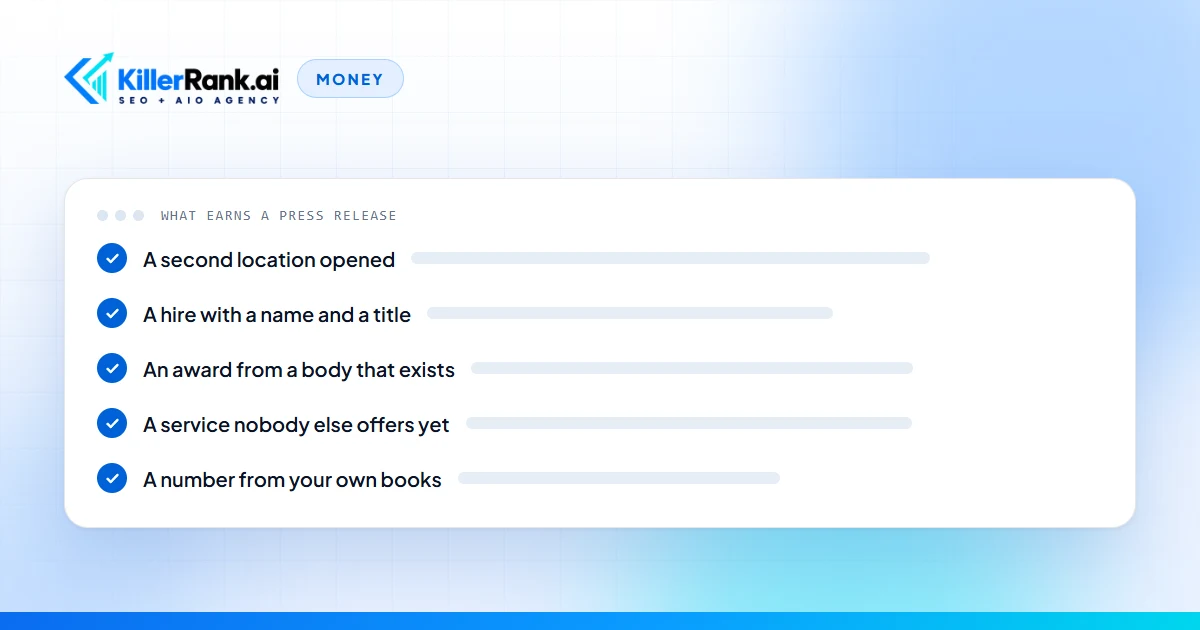
The test is one question: could a local reporter write a headline from it? Here is the list that passes.
You opened a second location, or moved to a bigger one. You hired someone whose name and title mean something in your market, a new service manager, a certified estimator, a partner. You won an award, and the body that gave it exists outside your own website. You added a service nobody else in your area offers, or you are the first in your trade locally to carry a certification. You hit a milestone you can prove with your own numbers: a thousandth job, twenty years in business, a fleet that doubled. Any of those is a release.
Here is the list that fails. A release announcing that your company offers your core service. A release about a blog post you published. A release that celebrates your commitment to quality. A release every month because the plan includes one every month. We see these on competitor quotes dressed up as monthly PR, and they produce nothing because there was nothing in them.
This is why the packages post teaches the line test for every bullet on a quote: what is it, how many, and where will I see it. Apply it to the press release line. What will the release announce? If the honest answer is nothing yet, the line should be a quarterly option tied to a real event, not a monthly fee.
Why is the press release on Authority and Dominate and not on Starter or Growth?
Read the plans page for the full ladder. Every price in this post is the price on that page today.
Starter at $997 a month is the engine: four posts a month, 50 keywords and 60 AI questions tracked, your Google Business Profile posted weekly, listings cleanup and the technical work. Growth at $1,997 adds two authority links and two new pages a month, the Where We Serve map and 25 citations a year. Neither includes a press release, and that is a decision, not an omission. A business on those plans is building the pages a release would send people to. A release in month two pointing at a site with one thin service page wastes the coverage.
Authority at $2,997 a month is where the release starts: one each quarter, written by us about something your business did, distributed on the national newswire, alongside four links and four new pages a month. Dominate at $4,997 runs a release every month plus direct pitches to reporters who cover your industry, because a business at that level in a crowded market usually does have news every month and a reason to be in front of trade press.
One first hand detail about how that line got written. When we built our own plan sheet in September, the higher tiers carried a line that read monthly press outreach. It came out before the sheet went live, because it did not name a deliverable an owner could check. What replaced it is a count: one release a quarter on Authority, one a month plus reporter pitches on Dominate, each tied to an announcement you approve before it goes out. Our how it works page shows where that sits in the month. The guarantees post covers the general rule behind that edit: a company can guarantee a count and a cadence, never a pickup or a position.
How should you read the press release line on someone else’s quote?
What will the first release announce? If the salesperson cannot name an event, the release is a monthly fee for a document about nothing.
Where does it go? You want the name of the network and whether that network reaches real news pages. Distributed to 500 sites is a copy count, not an answer.
What will the links say? The right answer is your company name pointing at your homepage. If the answer involves your keywords, you have found the thing Google’s link spam policy names, and you should keep walking.
Are the copies counted as links? If the two links a month on the quote turn out to be two releases a month, the links line is empty. The cost post shows how to lay two quotes side by side so a padded line stands out, and the cheap SEO post covers the version where the release is the whole package.
Do I approve it? A release goes out under your name. You read it first, every time.
If a vendor answers those five cleanly, the press release line is honest and you can decide whether you have the news to justify it. If they do not, the contracts post has the clause wording that keeps you month to month while you find out.
To see where your site stands on the searches that actually bring in work, before anyone sells you a release about them, run the free audit. It takes about a minute. When you have something worth announcing, the seven day free trial starts with the foundation a release should point at.
Questions We Get Asked
Are press releases good for SEO?
Indirectly, and only when there is something to announce. A release on the national newswire puts a dated third party record of your business on news pages, earns a short run of coverage, and gives you something to send buyers. It does not raise your rankings by itself, and the links it produces are not authority links. Buy it for the announcement, never for the backlink count.
What is a press release in SEO?
It is a written announcement about your business, distributed through a newswire to news network pages and the affiliate sites that run the same feed. In an SEO package it is usually one line, priced into a higher tier. Its SEO value is the record it leaves and the coverage it can start, not the links, which Google's spam policy treats as link spam when they carry keyword anchor text.
How many backlinks does a press release give you?
A backlink tool will show you hundreds, because every affiliate page that runs the release counts as a referring domain for as long as the copy stays up. Those are syndication copies of one story, they pass little or no ranking credit, and many are removed within weeks. Count a press release as one placement with one link, and judge it on the coverage.
How often should a small business send a press release?
As often as you have a real announcement, and no more. For most small businesses that is a few times a year: a new location, a key hire, an award, a new service, a milestone. Our Authority plan sends one each quarter and Dominate sends one a month with reporter pitches, and on both the release is tied to something that happened, never written to fill a slot.
How much does a press release cost?
We do not sell one on its own, so there is no standalone price. It is included quarterly on Authority at $2,997 a month and monthly, with direct pitches to reporters who cover your industry, on Dominate at $4,997 a month. Every price in this answer is on our plans page today. If a release is the only thing you want, you do not need an SEO plan to get one.