Every owner who has been burned by an SEO company likes the sound of pay for performance. You pay when you rank. You pay when the leads come in. No result, no bill. After a year of paying a retainer and reading reports that said “in progress”, it feels like the first fair deal anyone has offered you.
I run the search work for a few dozen small businesses, and I have read a lot of these contracts, usually after an owner signed one and then asked me what went wrong. This post is what the fine print actually says, where the risk really sits, and how to turn a pay on results pitch into something you can hold a company to. The guaranteed SEO services post covers what any company can honestly promise. This one is about the pricing model, which is a different question with a different answer.
What is pay for performance SEO, and who picks the keywords?
The model comes in three flavors. Pay per ranking charges a monthly fee for each keyword sitting on page one, or in the top three, with a higher fee for the higher spot. Pay per lead charges for each form submission or call. Pay per traffic charges on visits above a baseline. All three sound like the company is taking the risk. In all three, the definitions decide who really is.
Start with the keyword list, because it is the price list. Here is why that matters, from a client we track: a local pet guide and events site in an Ohio city with 75 searches tracked. As of the October 26, 2026 scan, it is in the top three on 5 of them, on page one for 20, and nowhere at all on 41. The five it wins are the searches that name what the site is, a pet magazine for its city. The 41 it does not rank for are the searches a stranger types: dog grooming, emergency vet, pet boarding, dog training, each with the city name attached.
Now imagine a pay per ranking deal on that site. If the company picks the list, it picks the five. It gets paid from month one for positions the site already held, and the 41 searches that would bring a new customer never make the contract, because nobody gets paid to attempt them. If you pick the list, you pick the 41, and the company quietly tells you those terms are “not a fit for the model.” Both answers tell you what the model is for.
What counts as a result in the fine print?
Four questions expose the definitions. Which device: Google shows one result on a phone and another on a desktop, and most contracts pick whichever is kinder. Which location: a company with one address ranks differently in every town around it, and the contract usually measures from the town where it ranks best. Which day: a position checked once a month on the day the company chooses is a snapshot, not a ranking. And how long: page one for one scan is a result in most of these contracts. Page one for a month is a result an owner would recognize.
Traffic has its own trap. Sessions include your own staff, bots, people who clicked the wrong thing, and readers of a blog post who will never buy. Leads have the worst one. A form submission is a lead unless the contract says otherwise, and the vendor who sends you three pitches a week through your own form is counted. The monthly SEO report post is about reading positions next to clicks for this exact reason: a position with no click behind it is a number, not a customer.
Where does the risk actually sit in a pay on results deal?
Follow the money for a year. Month one, the company pushes the terms it chose, the ones already close, and bills for most of them. Months two through six, the hard terms sit where they were, and nothing on the invoice changes because the easy ones are still holding. You have paid every month. You have not received the thing you hired for. That is the normal shape of these deals, not the failure case.
Then there is the method. A company that earns nothing until a position moves is paid to move it fast, and fast has a known menu: bought links, pages produced at scale, exact phrase repeated until the copy reads wrong. Google’s spam policies name all three. The penalty, when it comes, lands on your domain, not theirs, and it arrives after the contract ends. The cheap SEO post shows what a bought link package leaves in a backlink profile years later. A results deal buys the same thing with a different invoice.
One more question before the method: what do you own when you leave? Some of these contracts keep the content, the pages, even the links pointing at your site, because the company “earned” them. The SEO contracts post has the ownership clause to strike. A result you cannot keep is a rental.
Why does a ranking move too much to bill on?
Here is real movement from our own tracking, anonymized. The client is a trucking and storage trailer rental company in the Midwest with 19 searches tracked, checked every week on desktop, on phones and in Google Maps. Across the terms that ranked, its average position went 28 on October 5, 22 on the 12th, 16 on the 19th, 11 on the 24th, and back to 16 two days later on the 26th. Under a pay per ranking contract that checks once a month, the 24th bills and the 26th does not, and the company picks the date.
Single terms are wilder. Storage trailers plus the name of a city an hour north: 4 on phones in the first scan, 34 four weeks later, while desktop went the other way, 44 to 36. Semi trailer rental in that same city: 15 on desktop in the first scan, 50 by October 26, while phones showed it at 9. Semi trailer rental in the home city: desktop fell from 24 to 49 and Maps rose from 21 to 10 over the same weeks. Same company, same pages, three channels, three different stories. A contract that says “page one on any device” bills on the kind week and stays silent on the other.
The pet guide shows the same thing from a stronger position. The search that names what it is, a pet magazine for its city, sat at 1 on desktop and 2 on phones at the start of October and at 26 and 34 by the 26th. A sponsorship search went from 5 to 71 on desktop while phones held it at 2 the whole month. Nothing on the site changed. Google did. That is why we track every term weekly on three channels and show all of it in the dashboard, and why we would never bill you on one of those numbers. The is SEO worth it post has the math on what a customer is worth; a position is not in that math at all.
What does the honest version look like?
This is how we run it, and the numbers are the ones on our plans page today. Starter is $997 a month: four blog posts, your Google Business Profile kept accurate and posted to weekly, business listings cleanup, the technical, schema and page speed fixes, 50 keywords and 60 AI questions tracked, a monthly report and a strategy call. Growth is $1,997 and adds eight posts, two authority links a month, two new pages a month, 25 citations a year and the Where We Serve map. Authority is $2,997, Dominate is $4,997. Billing is monthly, in advance, month to month until you cancel. You pay nothing for the first seven days.
Notice what that structure does to the risk. Every line is a thing you can count on your own site at the end of the month: the posts are live or they are not, the pages exist or they do not, the links are named by site in the report. The result is tracked in the dashboard on desktop, mobile and Maps every week, and the AI tools are checked for whether they name you, so the climb is visible without being the thing you are billed for. We guarantee the work, never the result, and the how it works page shows the first ninety days in order.
A hybrid can be honest too. A base fee that covers the named work plus a bonus when an agreed term holds a position for three months is a results component on top of a real plan, and it keeps the company’s incentives pointed at the terms you chose. The problem was never the word performance. It was a deal where performance is the only thing paying the bills.
How do you turn a results pitch into a written deliverable?
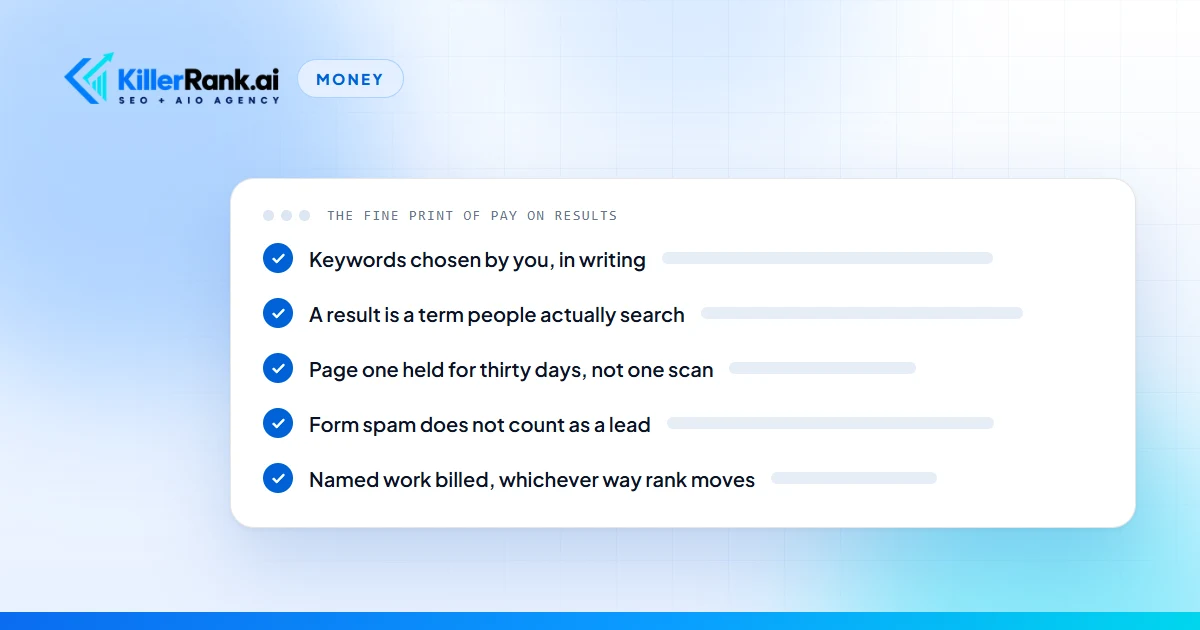
Take the four in order. The keyword list: every term printed, each with its monthly search count from a real tool, each approved by you, and no term added later without your signature. If a term gets fewer searches a month than you get calls a week, strike it. The measurement: desktop or phone, which town, and which tool, written down, with you able to see the same tool. The duration: a result bills after it has held for four consecutive weekly scans, not one. The lead: a new person asking about a service you sell, with spam, existing customers and sales calls excluded, and a dispute window.
Then ask the question the pitch is built to avoid: what work happens? If the answer is that the work is theirs to decide and you are paying for the outcome, you are buying something you cannot inspect, and the how to choose an SEO company post has the rest of the questions to ask before you hire anyone. A company that is proud of its method will list it. One that hides behind the result usually has a reason.
If the company agrees to all of that, you have converted a pay on results pitch into a fixed scope with a results bonus, which is the honest hybrid above. If it refuses any of the four, you have your answer about what the deal was selling. Either way you learned it before the first invoice instead of after the twelfth.
Before you sign a pay on results deal
Pay for performance SEO is not a scam by definition, and it is not a guarantee either. It is a pricing model whose fine print decides who carries the risk, and the fine print is almost always written by the side that wrote the keyword list. The cost post gives the pricing models side by side if you want the comparison, and our SEO company for small business page says plainly what we do for a fixed fee.
If you are weighing one of these deals, start with the free audit. It shows where your site actually stands on the searches you care about, which is the number you need before anyone sets a price on moving it. And if you would rather pay for named work and watch the result in the open, the seven day free trial starts with nothing charged and every plan listing what you get.
Questions We Get Asked
What does a lead mean in a pay per lead SEO deal?
Usually anything that comes through the form or the phone. Read the definition, because that is where the bill lives. Insist in writing that spam submissions, existing customers, job seekers, sales calls from other vendors and wrong numbers are excluded, that a lead has to be a new person asking about a service you sell, and that you have a set number of days to dispute each one. Without that sentence you are paying per form fill, and half of what a form collects is not a customer.
How much does pay for performance SEO cost?
There is no single price. The fee is set per keyword per month, per lead or per visit in the contract, so the total depends on how many of the chosen terms move and how the result is defined. That is why the keyword list is the real price list. For comparison, our plans are a fixed fee: $997 a month on Starter up to $4,997 on Dominate, as printed on our plans page today, with the work named on the page and billed monthly, month to month.
Is pay for performance SEO legitimate or a scam?
It is a legal pricing model and some companies run it in good faith, so it is not a scam by definition. The problem is structural. The company earns nothing until something moves, so it is paid to pick terms that move fast and to use methods that move them fast, and Google's spam policies name the usual methods: bought links and content produced at scale. The deal can be honest and still be a bad deal for you, because the incentives point at the wrong terms.
Can an SEO company guarantee a page one ranking?
No, and a pay on results deal does not change that, it only changes who pays when the guess is wrong. Google shows a different result on a phone than on a desktop, in each town, and from one week to the next, so there is no single position to deliver. Our guaranteed SEO services post walks through what a company can honestly put in writing: the work, the cadence, the report, your ownership and your exit.
Does KillerRank offer pay for performance pricing?
No. Every plan is a fixed monthly fee for named work: the posts, pages, links, profile work, listings cleanup and technical fixes are listed on the plan page before you buy, and the dashboard shows your positions on desktop, mobile and Google Maps every week along with whether the AI tools name you. You pay nothing for the first seven days, billing is month to month, and you can leave at the end of any month. We guarantee the work, never the result.