Most of what gets written about SEO assumes your customer is a homeowner. Somebody with a leaking roof types roofer near me, the map comes up, and the business with the best profile and the most reviews gets the call. That is a real market and we work in it every day.
It is not your market if you sell to other businesses. I run SEO for a commercial paving company that sells to property managers across several states and for a national commercial collections firm with offices in two states, and both taught me the same thing: the playbook that wins a plumber his phone calls will waste a B2B company’s money. This post is what changes, with their real numbers as of this week, and what you should be sold instead.
What changes about SEO when your customer is another business?
The work itself does not change. What changes is what you aim it at, and what counts as a result.
A homeowner decides in an afternoon. A property manager who needs parking lots repaired across twelve apartment complexes decides over a quarter, after reading, after a quote, after a reference. A controller who needs a commercial collections firm reads three articles before she searches a single company name. If your SEO company plans the month as if those buyers behave like the homeowner, you get a Google Business Profile with weekly posts and a report full of map positions, and none of it touches the people who sign your contracts.
Our SEO company for small business page covers what the engine does for any business. This post is about where to point it.
Why do fewer searches matter more when you sell to businesses?
Here is the collections firm’s Search Console for the 28 days to October 16, 2026. The whole site drew 295 clicks on 15,376 impressions. More than half of those clicks were people searching the firm’s own name.
Now look at the search that matters commercially: accounts receivable outsourcing. The site was shown 263 times for it, at an average position of 16, and earned no clicks. A second spelling of the same phrase added 70 impressions, also at zero. A homeowner facing service would shrug at 333 impressions a month. For this firm, the company typing that phrase has a receivables problem big enough to outsource, and one of them signing is worth more than a hundred roof repairs.
That is the first thing to understand about B2B SEO services. The keyword list is short, the volumes look unimpressive, and each position matters enormously. Position 16 is page two, and the whole job on that search is to get the right page to the top of page one. So when a company pitches you on tracking 500 keywords, ask which ten of them a buyer with budget actually types. In B2B, those ten are the business. The cost post explains why a quote built on volume numbers can miss this entirely.
Does the Google map still matter when you sell to businesses?
The paving company makes this plain. In the 28 days to October 16 its site was shown 17,345 times and clicked 77 times, a click rate under half a percent, at an average position around 13. The single biggest search was the generic phrase pothole repair: 5,164 impressions at position 13 and eight clicks. That phrase is mostly homeowners and city residents, and this company does not fix driveways.
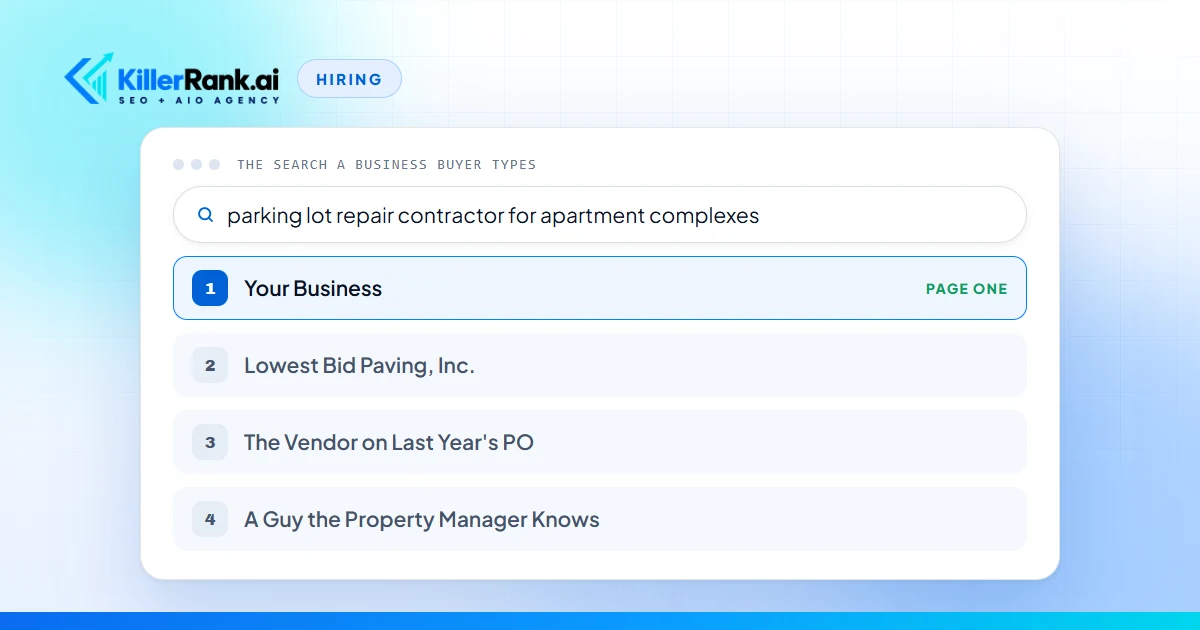
The searches worth money look different. One was a property manager’s phrase: apartment complex parking lot repair plus a city name. Thirty nine impressions in 28 days, average position 4.4, no clicks yet. Tiny volume, exactly the right buyer, one or two spots below where it needs to be. The metro pages tell the same story: one drew 1,063 impressions at position 27 and another 816 at position 22, while two others sat at positions 9 and 10 and were already earning clicks. The job is obvious: move the metro pages stuck in the twenties, and build the page for the property manager’s search.
None of that happens on the Google map. A map pin is tied to an address, and a company that serves twelve metros from one office can only appear on the map in one of them. The multi location post covers why a page per market beats a list of cities. The same logic applies to industries and services: a page for property managers, a page for hotels, a page for the exact job, written for that buyer and reviewed by you.
The map keeps one job: a buyer who finds your name will look you up, so keep the profile accurate (the Maps post has the checklist). Just do not let anyone sell you a B2B plan whose centrepiece is weekly profile posts.
Why do AI answers matter more for a B2B company?
Every plan we sell tracks whether ChatGPT, Claude, Gemini, Perplexity, Grok and Meta AI name the business when someone asks a real buyer question. For a B2B company those are the questions a controller or a facilities director types at her desk, and the pattern in the answers is the most useful thing in the report.
Take the collections firm’s sweep from the week of October 19: 65 questions, each put to all six tools. Overall it was named in about 10 percent of the answers, from 6 percent in ChatGPT to 12 percent in Claude. The average hides the lesson.
On the three questions that used the firm’s own name, all six tools named it every time. On the questions a buyer asks before knowing any names, it was named in four of six answers when the question was about industry certification, and four of six when the question was which agencies can collect in all fifty states. Those are credential and coverage questions, and the firm has pages that answer both plainly.
On the question that matters most, what should I look for when hiring a commercial collection agency, it was named in zero of six. Same for what does a commercial collection agency charge, and for which agencies are the most reputable. The tools answered with somebody else’s content, because the firm has not yet published that page.
The paving company shows the same mechanics from the other side. On how to get municipal contracts for pothole repair, a question only a commercial buyer asks, it was named in five of six answers in the week of October 12. On who is responsible when a pothole damages my car, it was named in none, which is exactly right. A B2B company wants to be named where business buyers ask, not everywhere.
So when a company sells you AI SEO services, ask which buyer questions they will track, and ask to see the answer that named a competitor. The AI SEO services post covers what should be on the invoice, and why ChatGPT recommends your competitor explains the page per question pattern you just saw. Our AI SEO services page is what we do about it.
What should the monthly report show when the sales cycle is long?
A roofer can read his SEO report by the phone. A B2B company cannot, because the buyer who found you in month one requests a quote in month two and signs in month four, and she probably came back through a search for your name. Look again at the collections firm. Its three most shown pages were how-to articles on collection letters, payment terms and collection calls: 11,561 impressions between them in 28 days and 52 clicks. Its homepage drew 2,220 impressions and 205 clicks, most of them on the firm’s name. I cannot prove every name search started with an article. But that is the shape of a B2B funnel, and a report that only counts the homepage will say the articles did nothing.
Here is what the report needs to show instead. The work by name: which state, industry and service pages went live, which articles, which links. The searches that matter, read next to clicks, with the ones stuck on page two called out. The AI column: which tracked buyer questions named you this month and which did not. And the B2B part, forms and quote requests tied to how the person found you. Every plan we sell includes lead source tracking on your site, so a form enquiry shows the search or page that produced it.
The report post covers how to read any SEO report. For a B2B company, add one question to the strategy call: which quote requests this month came from pages you built. If nobody can answer, the tracking is not wired, and that is the first fix.
Do you need a B2B SEO agency, or an SEO company that understands your buyer?
B2B SEO agency is a phrase a lot of companies have put on their homepage because business owners search for it. Some have done the work for years. Some renamed a local SEO package last quarter. Four questions separate them.
Which pages will you build in month one, and for which of my buyers? You want to hear states, industries and services, in an order that starts where your revenue is. A vague content calendar is a no.
Which buyer questions will you track in the AI tools, and can I see the current answers? You want the real question, and the competitor the tools currently name instead of you.
How will a quote request show up in the report? The page or search it came from, not a total.
What are the terms? Month to month, your site and your content stay yours, and you can leave at the end of any month. The contracts post has the clauses to hold out for, and the hire post covers whether you need a company at all or a person on your team with a plan.
One honest note. Some professional services firms selling to a narrow set of large accounts are better served by referrals than by search, and a good SEO company will say so after reading your Search Console. The worth it post has the math, and it works the same whether your customer is a homeowner or a hospital group.
Which plan fits a business that sells to other businesses?
Read the plans page for the full ladder. Every price in this post is the price on that page today, and nothing else.
Starter at $997 a month is the full engine: four posts a month, 50 keywords and 60 AI questions tracked, the profile, listings cleanup and the technical work. It fits a B2B company that mostly needs to be found by name in one market, and it does not build new pages or earn links, on purpose.
Growth at $1,997 a month is where most B2B companies should start, because it adds two new pages a month in the order you choose, two authority links a month, a Where We Serve map on your homepage, 25 citations a year, 150 keywords and 100 AI questions. For a company that sells across several states, those two pages a month are the state pages, built in the order of your revenue. That is how the collections firm is set up, and the order of its states was the owner’s call, not ours.
Authority at $2,997 a month doubles the links and the pages to four a month, and it is the first plan that builds industry and service pages alongside the places, with 300 keywords and 150 AI questions tracked and a quarterly press release on the national newswire. If your buyers are property managers, hospital groups and school districts rather than everyone in a state, this is the plan that writes the page for each of them, and where the paving company’s property manager search gets its own page. Dominate at $4,997 a month, with eight pages and eight links a month, is for a crowded national market, and most B2B companies do not need it on day one.
Whichever you pick, the first month is the same: Search Console connected, profile and listings made accurate, technical faults fixed, tracking live, first pages chosen with you. Our how it works page lays out the four steps.
To see where your site stands on the searches your buyers actually type, run the free audit. It takes about a minute. When you are ready for the first state or industry pages, the seven day free trial starts with the setup done.
Questions We Get Asked
What is B2B SEO?
B2B SEO is search work for a company whose customers are other businesses: commercial contractors, professional services firms, suppliers, agencies. The mechanics are the same as any SEO, but the targets change. Fewer, higher value searches, pages for each state, industry and service you sell into, AI answers that name you when a buyer researches vendors, and a report that tracks quote requests instead of walk-ins.
Is SEO worth it for a B2B company?
Usually more so than for a consumer business, because one new account is worth far more than one new customer. The math is the same as any business: what is a new client worth over the years you keep them, how many a year would cover the fee, and how many of the searches you want are already being won by competitors who publish. Our worth it post walks through it with blanks you fill in.
How is B2B SEO different from local SEO?
Local SEO lives on the Google map and the near me searches, where a profile, reviews and distance decide who gets the call. B2B buyers rarely search near me. They search the service, the industry and the market, so the work shifts to state, industry and service pages, to being named by the AI tools, and to a report that shows pipeline. The profile still has to be accurate, it just stops being the main event.
Do B2B companies need a Google Business Profile?
Yes, keep it accurate and in the right category, because a buyer who finds your name will check it, and the AI tools read it to confirm you are real. Just do not expect it to produce the account. A commercial paving company we run gets its real demand from metro and service pages and from being named in answers about commercial work, not from a map pin. The profile is table stakes, not the strategy.
Which B2B SEO agency is the best?
Nobody can honestly tell you that, and a company that claims it is selling. Judge one the way you would judge any vendor: ask which state, industry and service pages they will build in month one, which buyer questions they track in the AI tools, how quote requests will appear in the report, and whether the terms are month to month. The answers tell you more than the word agency ever will.